American Democracy Needs Long-Term Planning
The next chapter will arrive in some way, share, or form--and we need a plan.

Whatever cat we let out of the bag 10 years ago when Donald Trump came down his gilded escalator cannot be re-captured. It’s out and it’s ripped our house to shreds. Despite a four-year sojourn where he was blessedly no longer the president, Trump and his aggressively anti-constitutional form of politics and government have dominated the national discourse for a full decade.
Despite teases that he’d run for an illegal third term, at least some in Trump’s orbit see the end. A modicum of quiet planning for his presidential library is underway. It’s as good a sign as any that—despite the chaos, violence, and harm of his presidency—some understand that Trump is a second-term president, and, with that, a lame duck (albeit a lame duck with the ability to destroy America as we know it).
Come noon Eastern time on January 20, 2029, Trump’s presidency will end. He’s obliterated American norms and put our nation, the people (citizens and non-citizens alike), and its guiding documents through one hell of a stress test. Too often, we’ve failed to meet the moment. A twice impeached, convicted felon, who was also criminally charged with trying to overturn the 2020 election managed to recapture the presidency just four years later. His second term is a revenge tour fixated on going after perceived enemies—people and institutions—who he believes wronged him.
Make no mistake, we are in extreme danger.
Whether we make it through his second term or not remains to be seen, but it’s time for some long-term planning to ensure this cannot happen again.
The Constitution—as it stands—is a nearly 240-year-old document. When the Constitution was written and adopted, wealthy white men held the vast majority of the power. Most Black people in America were slaves. Women had few rights (and wouldn’t secure the Constitutional right to vote for more than 130 years after the Constitution’s ratification). It would take another 45 years for Black Americans to secure critical civil and voting rights laws, which were never fully enshrined into the Constitution. It was and still is, to put it mildly, a deeply imperfect document. Since amended 27 times to reflect a changing society, the Constitution still often comes up short and is left up to the interpretation of increasingly ideological jurists, whose motives seem more focused on creating the America they want rather than interpreting the law.
Sometimes that’s supported progress. Too often, it’s supported a regressive system, one focused on stripping, rather than expanding, rights.
A constitution left up to interpretation is both a blessing and a curse. As the Trump Administration continues to wield power like a mad king, disappearing people to foreign gulags, shredding the federal government and the workers who ensure its functionality, and attempting to manipulate the powers granted to the executive in Article II into something more befitting of a dictator, the courts have restrained some of Trump’s worst intentions. Yet, in recent years, the Supreme Court has interpreted the Constitution in alarming ways, using it to strip fundamental freedoms from women, and remove guardrails that prevented states from unjustly curtailing the voting rights of Black Americans, while granting corporations rights to political speech, and dramatically expanding executive power. These are just some of the myriad decisions that put ideological interests ahead of the people.
Still, we shouldn’t be here in the first place. Some of that is on our broken politics, yes, but it’s easy to blame polarization or a failing two-party system for leading us toward American democracy’s end. Regardless of the how, this is the path we’re currently on. There’s no changing that. We can blame the media, social media, our politics in general, gerrymandering, voter suppression laws, or Citizens United to explain how we arrived at this point, but the die was cast long ago. Trump’s term will end, but our politics will not simply return to normal with his presidency entering the history books (for real this time). Much of our current predicament predates Trump. He simply exploited the cracks in the system. It’s now a chasm wide enough to swallow the country whole.
So, what do we do?
Right-wing groups have long toyed with the idea of pursuing an Article V constitutional convention, allowing for the wide-scale rewriting of the Constitution. Given the makeup of state legislatures skewing in favor of conservatives, it was reasonable to assume that an Article V convention would lead to the undoing of the American system as we knew it. Perhaps the Unitary Executive theorists would further undercut Article I, providing additional powers to the executive. At the very least, it would further erode and undermine democratic norms and the separation of powers. At worst, it would strip people of their rights, roll back constitutional guarantees of civil rights, and fundamental freedoms of speech, expression, assembly, the press, and separation of church and state. There are no rules for an Article V convention, so we’d be operating without a compass.
Groups like Common Cause have long warned of the dangers of an Article V convention—and for good reason.
During Trump’s first term, I was talking to a colleague far, far smarter than me about our pathway out of the madness. A well-educated lawyer and a deeply progressive person, he showed less fear over what an Article V convention might mean for the future of American democracy. He even seemed to suggest it was an imperative. This was around 2018.
An Article V convention scares the shit out of me and I imagine we’d want to avoid it. I don’t know if there’s a right or easy answer. I’m not that smart, but I recognize the need to plan for the future before it arrives.
I realize I’m writing this as Trump’s secret police roam American streets kidnapping people and a new war is getting underway in the Middle East. But, we need to figure out how to walk and chew gum at the same time. We can address the myriad crises we face in this moment while acknowledging a need to start long-term planning.
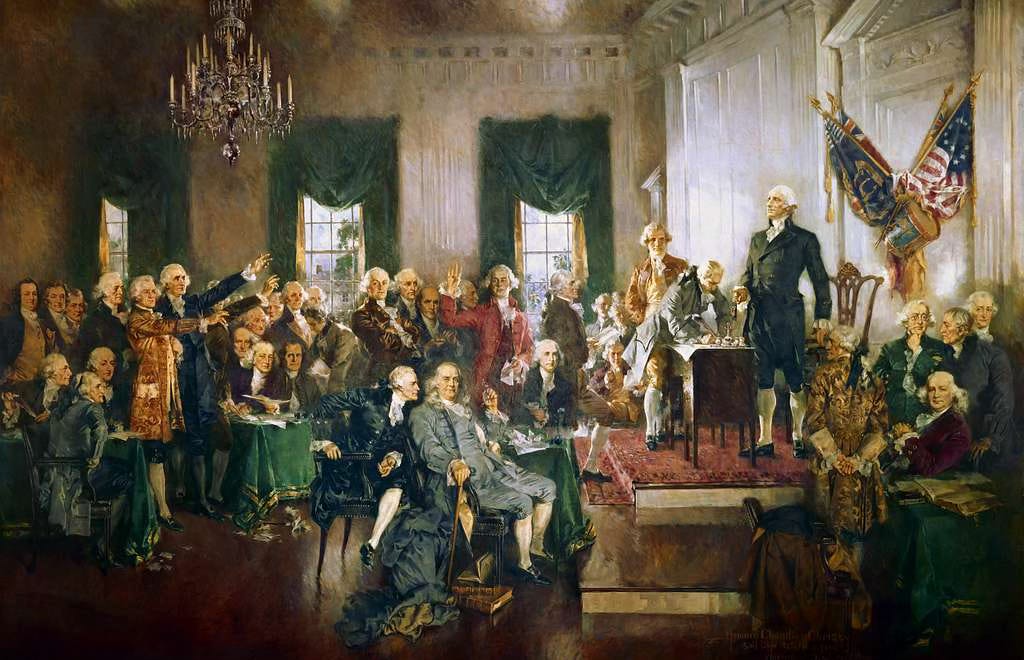
We can and should start convening the brightest minds. Historians, futurists, activists, workers, unions, politicians (the good ones, I promise), educators, academics (also the good ones!!), economists (also the good ones!!!), and start genuine discourse around the future of America. Maybe we gather in Philadelphia in Independence Hall and start there? Again—I don’t know. I’m spitballing here.
At some point, this era will end. Those who are most prepared for what comes next will likely lead the way. What we start now will define what comes next. I’m not particularly well equipped to organize this conversation (I’m just a schnook with a blog), but let’s get this conversation going. The future of our democracy might depend on it.